Loading control
- Payload optimisation
- Dimensional limits
- Safe loading practice
- Legal mass or applicable permit
Established in 1981 by Daan Joubert Snr, Payloads is a bulk transport company based in Krugersdorp providing transport services to the mining, agricultural and the fuel industries.

Payloads specializes in short, medium and long-haul transport solutions to our extensive customer base which includes Glencore, Samancor, GMSA and Metal Line Africa to name but a few.
Our offices are based in Krugersdorp. We operate 2 shifts, 24 hours per day from Monday – Friday and 1 shift over weekends which allows us to effectively maximise our fleet capabilities as well as customer expectations.
Our 24 hours shift based model ensures that our drivers are well rested and operate within the legal framework as determined by the NBCRFLI, RTMS and Department of Labour.
Payloads operate a fleet of Side Tippers, Back end Tippers and Tankers vehicle combinations to meet our customer’s requirements.
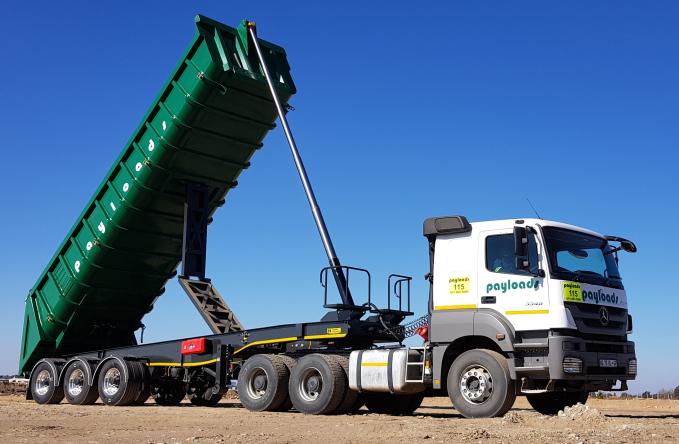
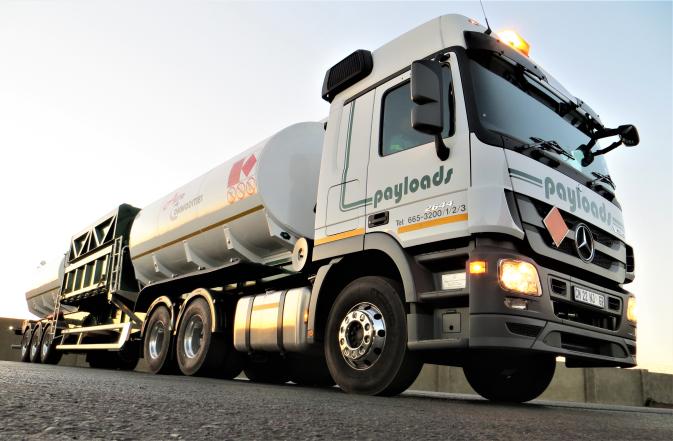
RTMS and NBCRFLI
RTMS (Road Transport Management System) is a voluntary, industry-led, and government-supported scheme aimed at improving road safety and infrastructure preservation within the heavy vehicle industry.
Being RTMS accredited gives our customers peace of mind and ensures that our operations are based on best practices and that we are measured every year against best practices in the transport industry.
Payloads is also registered with the National Bargaining Council for the Road Freight and Logistics Industry which governs all driver related issues for transport companies in South Africa.
This ensures that our drivers are being paid fairly. This is important to our customers, as well-paid drivers are less likely to be involved in illegal activities.
It is worth noting that many transport companies in South Africa do not comply.
RTMS runs on evidence, and evidence goes stale between audits. Payloads keeps all five pillars audit-ready every day, so your annual surveillance is a formality, not a scramble.
Every count links straight to the underlying records. Nothing is assembled by hand. Figures shown are an example of the pack’s layout, not a live readout.
What RTMS actually is
The Road Transport Management System is an industry-led, government-supported, voluntary self-regulation scheme for the heavy vehicle industry. It asks consignors, consignees and operators to run a management system that demonstrates compliance with the road traffic regulations, preserves road infrastructure, improves safety and lifts productivity. It supports the Department of Transport's National Overload Control Strategy.
The national standard is SANS 1395-1:2019, published by the South African Bureau of Standards and assessed by SANAS accredited third party certification bodies. It is not law. It has nonetheless become a contractual requirement across government freight tenders, mining and forestry supply chains and large corporate logistics, and it is a prerequisite for running a Performance Based Standards vehicle.
The reason to hold it is simple. An RTMS certificate tells a client, before they award the work, that your operation poses a minimal risk to their goods, their reputation and the road. That is a commercial asset, not a compliance cost.
The scheme, in numbers
The standard, mapped to the product
The problem Payloads solves
Most operators pass the first audit. They buy the standard, write the procedures, implement for three months and certify. Then the file goes quiet. Twelve months later the surveillance audit arrives and someone spends a fortnight rebuilding evidence that should have accumulated on its own. That fortnight is where certifications are lost.
Payloads closes that gap by treating evidence as something the operation produces, not something a person assembles. Each pillar maps to a control, each control points at a stored query, and the query returns a live count, the date of the most recent record and a link straight into the underlying documents. The audit pack regenerates on the morning of the audit, current to that morning.
Evidence that regenerates itself does not go stale. That is the whole product.
The route, and where we fit
Obtain SANS 1395-1:2019 from the SABS. It sets out the detailed requirements against all five pillars. This step is yours, and it is the only one we cannot do for you.
We map the standard onto your operation, list every deficiency, and configure the controls and records each pillar requires. The requirement register becomes a live checklist rather than a document.
Loading declarations, daily inspections, driver medicals, service records and performance data flow into the system as the operation runs. Records are maintained for every vehicle, trip and driver, which is exactly what the standard asks.
Submit to a SANAS accredited certification body. When they audit, the pack is ready. When they return for annual surveillance, it is still ready, because it never stopped accumulating.
Why clients ask for it
When a consignor hands you a load, regulations 330A to 330D place duties on them too. They need to know your loading control is real, your mass checks are documented and your declarations are kept. RTMS certification tells them that before they award the work, which is why it increasingly appears as a line item in freight tenders rather than a nice-to-have.
The same certificate reassures an insurer after a claim, a mine before it grants site access, and a corporate shipper protecting its own brand. It is a single, independently audited signal that your operation is run to a standard, and Payloads is what keeps that signal true between audits.
No. RTMS is voluntary in law. It is an industry-led, government-supported self-regulation scheme built on SANS 1395-1:2019. In practice it has become a contractual requirement across government freight tenders, mining, forestry and large corporate logistics, and it is a prerequisite for Performance Based Standards vehicles, so for many operators it is commercially unavoidable even though it is legally optional.
A SANAS accredited third party certification body, not the RTMS office and not the government. The standard itself, SANS 1395-1:2019, is published by the South African Bureau of Standards. When choosing a certification body, confirm it holds current SANAS accreditation for SANS 1395.
You buy the standard, run a gap analysis, write your procedures and implement them, with records maintained for vehicles, trips and drivers, before you submit for audit. Implementation is usually run for around three months so there is real evidence to assess. Payloads shortens the documentation and record-keeping work substantially, but the implementation period still has to be genuine.
Certification is maintained through annual surveillance audits. The auditor checks that your five pillars are still operating and that evidence has continued to accumulate. This is where operators most often struggle, because a file assembled once for the initial audit has gone stale. Payloads regenerates the audit pack from live records, so surveillance is a review rather than a rebuild.
Loading control, driver wellness, safety and compliance, vehicle maintenance, and performance monitoring. Each is audited independently, and each maps to a set of records the standard expects you to keep.
Yes. A transport management system supports RTMS by storing loading declarations, driver and trip records, vehicle maintenance schedules and history, and reports on overloads, licence and roadworthy status, and incidents. The certification body assesses your implementation, and a system that captures the right records consistently is exactly what the standard asks you to demonstrate.
Bring a driver list, a vehicle list and your current records. In thirty minutes we will map them against SANS 1395-1 and show you exactly which pillars are audit-ready today and which would fail a surveillance visit tomorrow.
Built against SANS 1395-1:2019, published by the South African Bureau of Standards. RTMS is an industry-led, government-supported voluntary scheme. Certification is issued by SANAS accredited third party bodies. Payloads is a management system that supports RTMS implementation and is not a certification body.
SRL is our own in house sub-contractor with an unencumbered fleet, which allows us to increase our capabilities when needed. If extra loads are available, SRL will be the first sub-contractor used to ensure that maximum control is exercised if sub-contractor capacity is required.
Our workshop and staff is accredited to do all warranty, maintenance and preventative services at our own workshop on-site. From a vehicle availability and uptime perspective, this adds a huge advantage to our customers.
Being a family owned and operated business in its 2nd generation affords us an opportunity to react differently to market conditions and decision making by mitigating our risks based on a case-by-case scenario. This creates an advantage to our customers in terms of flexibility.
For any queries, please contact Daan Joubert Jr. on 083 285 0305 or daan@payloads.co.za
Postal
PO Box 4242
Luipaardsvlei
1743
Offices
1 Windsor Rd, Luipaardsvlei 246 IQ,
Krugersdorp, 1739
Send an enquiry
We answer during office hours, in order of arrival.
Opens your email to daan@payloads.co.za with these details filled in — or just call 083 285 0305.